You can usually hear a funeral procession in Haiti before you see it. A small marching band leads the way, followed by the hearse and all the friends and family walking alongside, in front of and behind that.
Yesterday, I heard one of these processionals making their way up the main road in Titanyen toward a cemetery. The trumpets were playing the melody line of “Mansion Over the Hilltop” and I caught myself singing along.
I’ve seen poverty up-close in ways I never expected over the past several months. Those experiences have led me to think about the relationship between poverty and hope. It seems that unimaginable poverty either results in unimaginable despair or unimaginable hope. Or maybe a bit of both.
This seems strange to write, but I do think poverty lends itself to hope. It’s an advantage, in a way. When you come from a culture (USA) that prides itself on anyone being able to succeed, you learn that you can literally have anything you want. If you work hard enough and take the necessary risks, however immoral or unethical, required to get there, anything you want badly enough, you can have. Really, anything you don’t have is your own fault, in a generalized way of speaking.
That may be true for the elite here but not for most Haitians. The less you have here, the less you have. Less money, less opportunity, less education, less access to medical care, less chances of your lifestyle changing.
And in that, there is a resignation to one’s circumstances. There is resignation of your own ability to do anything about it. And there is resignation to hope, hope for changes in government, hope for hand-outs, and eternal hope that there is more to be lived for than this current life. In resignation of self-ability, God becomes the only real hope.
This past week, I visited the local women’s prison with some of the leaders of Grace Church. I didn’t know what to expect, but I think I expected it to feel maybe scarier. Instead, the inmates and guards joked with each other. The 200+ women who live there graciously received the care packages the church had made for them, and many of them scrambled to write notes for the pastor to take-requests for money, medical needs, and prayer requests.
There was a section of the facility that was exactly what movies prepared me for, cages where 1-3 women per cell stayed locked in with their beds, their personal belongings, buckets, and toilets. That was probably less than a quarter of the prison population. The rest were split between three enormous holding cells, giant rooms lined with bunk beds, personal belongings, clothes hanging to dry, buckets of water, and I even saw a television mounted on one of the walls. It was a busy, noisy place, but really it was just groups of women, going about their daily lives, locked in and separated from their families.
When we arrived in front of a holding cell, our pastor prayed a blessing over the group. The women would file out and line up to receive their care package, and after they had their bag of hygiene supplies in hand, they filed back into that cell.
I was introduced to one woman because she was a family member of one of the church leaders who was also there visiting. She had been accused of an unspecified crime, and has lived in that prison for three months, waiting to see the judge. This is an unfortunately common story here. A simple arrest can mean serious time, with or without a conviction.
From Grace Village, we have a clear view of the prison, just down the mountain from us. At night, now, when I can look down and see the electricity is out there, I can’t not think of the women locked into these big, dark holding cells. No fans running, no privacy, not knowing when they might get out, a stone’s throw from my world but a galaxy away.
I know a lot of Haitian people now. Many of them haven’t been given what I’d consider their fair share in life. Especially among the elders that I get to serve, many live in real poverty. Many live without their complete family. Most struggle to meet basic needs for food and shelter.
Loss of parents, loss of dignity, loss of income, loss of children, loss of life, loss of comfort, loss of freedom, loss of innocence… the list of things lost is long. But, one thing many have not lost is hope. And that is worth more than anything.
I’m not saying that the women sitting in the Titanyen prison tonight are just smiling and humming and thinking about how hopeful life is. I’m trying to say that hope is as available to them as it is to me, and probably more so than it is to those who’ve never had to rely on it.
Romans 5:1-5 “Therefore, since we have been justified through faith, we have peace with God through our Lord Jesus Christ, through whom we have gained access by faith into this grace in which we now stand. And we boast in the hope of the glory of God. Not only so, but we also glory in our sufferings, because we know that suffering produces perseverance; perseverance, character; and character, hope. And hope does not put us to shame, because God’s love has been poured out into our hearts through the Holy Spirit, who has been given to us.”
 Friend’s new baby!
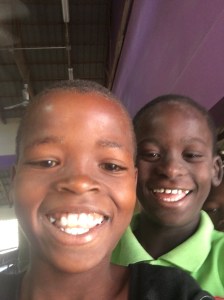
Some cute guys at church who wanted to play with my phone…
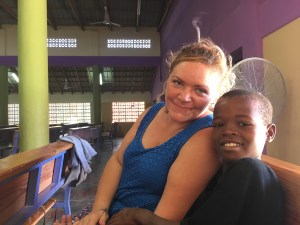
I mean, who wouldn’t want photos with me?
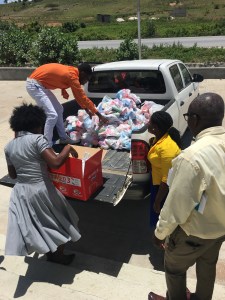 Unloading donations at the prison.
 The farm dogs know who brings them the good stuff! (It’s Kenny.)
 Meeting my newest favorite human. See you in three weeks, Marianna Rose!!!
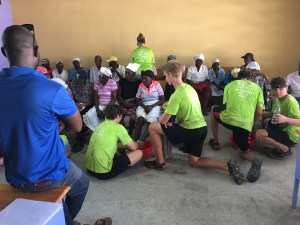 Team serving elders in Cite Soleil. ❤️
 royaltyintrainingblog
Bless you Katie. I can feel your heart in this blog. I know your feeling and miss it in my life everyday. Love them hard until you leave because when you come back home they will be hard in your heart and mind.
LikeLike